A standard is only as useful as the tools that speak it. Today we are excited to share that Label Studio, the open-source data labeling platform by HumanSignal, has shipped native DocLang support — visual editing, real-time validation, and direct export of .dclx archives. This makes Label Studio the first annotation platform to adopt DocLang as a first-class format, and it marks a significant milestone for the ecosystem.
Why this matters
DocLang was designed as the lossless interchange point between document understanding and downstream AI workflows. Conversion tools such as Docling can produce DocLang from PDFs, scans, and office files — but until now, dedicated tooling to create, review, and correct DocLang simply did not exist.
With Label Studio's native support, knowledge workers and data scientists can now build and refine ground truth directly in DocLang, without needing to run a conversion pipeline or hand-edit XML.
What Label Studio supports
The new annotation interface, co-developed by the Label Studio and DocLang teams, lets annotators work directly on rendered document pages. They draw bounding boxes for element types, define reading-order paths, and handle complex structures — ordered and unordered lists, merged regions, and detailed table layouts including spanned cells and table headings.
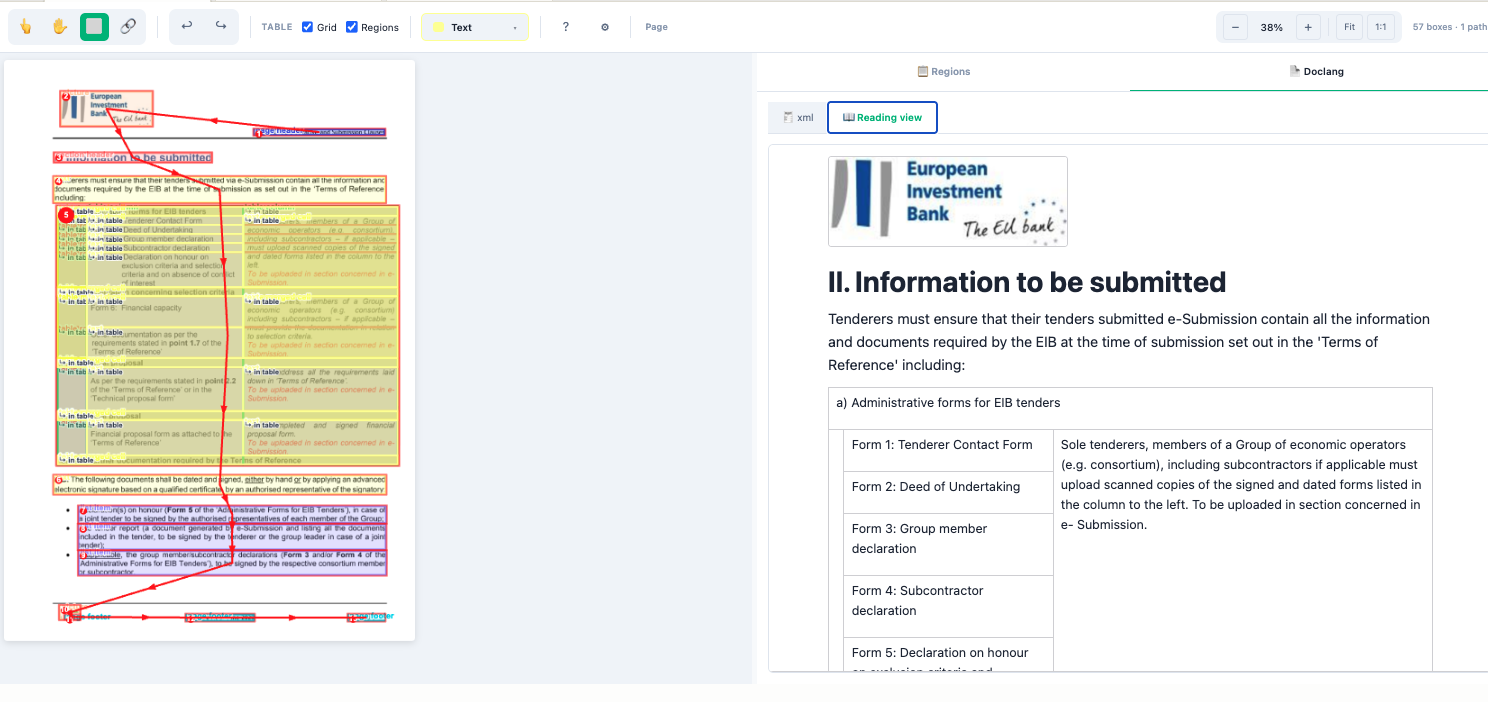
A live DocLang tab shows the resulting markup in real time, both as XML and as a rendered document preview, so errors immediately catch the eye. On export, annotations are packaged as .dclx archive files — the standard DocLang Archive format — containing the structural data alongside page images, ready for any downstream tool that reads the standard.
For full details on the integration, see Label Studio's announcement post.
What this unlocks
Ground-truth creation for any DocLang producer. Evaluation has always required gold-standard data. Label Studio now provides a dedicated interface for building that ground truth, and the resulting .dclx archives work as evaluation benchmarks for any tool or model that outputs DocLang — not just one specific conversion pipeline.
Fine-tuning data at scale. Adapting document-understanding models to custom formats requires correctly structured labeled examples. Starting from model predictions and correcting them in Label Studio is dramatically faster than annotating from scratch, and the .dclx export feeds directly into training pipelines that consume the standard.
The bigger picture
HumanSignal is a founding member of the DocLang working group under the LF AI & Data Foundation, alongside IBM, ABBYY, NVIDIA, and Red Hat. This integration is exactly the kind of independent tooling adoption an open standard needs: multiple producers, multiple consumers, and a shared format in between. We look forward to seeing more tools across the ecosystem adopt DocLang — and we welcome contributions from the community.